
Excavating Memory, Rewriting History: A Conversation with Peter Kimani

Kui Kabala
Thu, 5 February 2026
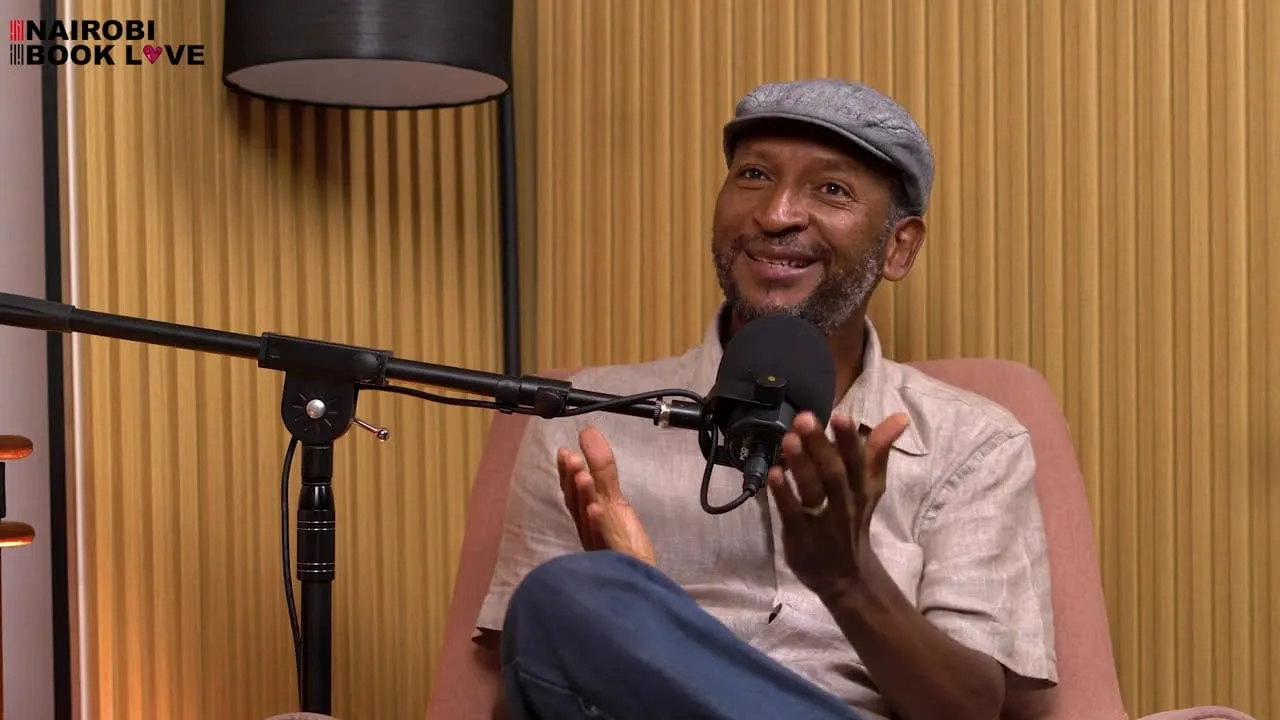
There are authors whose work you admire, and then there are authors whose work quietly reorganizes how you see your country. Peter Kimani belongs firmly in the latter category.
When he joined us on Nairobi Book Love: The Podcast, the moment felt full-circle. Dance of the Jakaranda, his celebrated historical novel, was the very first book Nairobi Book Love ever read as a community (co-read with Michelle Obama’s Becoming). What began as a reader’s curiosity (and a determined internet search for an elusive author with a limited social media footprint) has grown into an ongoing literary kinship.

Peter Kimani poses with members of Nairobi Book Love during the April 2019 Meet the Author discussion
Peter Kimani is many things at once: journalist, novelist, poet, editor, teacher—and above all, a restless excavator of history. His work insists that Kenya’s past is not settled, not neat, and certainly not owned by colonial archives.
A Writer Shaped by Fracture
Kimani’s literary journey cannot be separated from Kenya’s political ruptures. His 2011 Jomo Kenyatta Prize for Literature –winning children’s novel, Upside Down, emerged directly from the trauma of the 2007–2008 post-election violence. Written from the perspective of an eleven-year-old girl, the novel attempts what adult narratives often cannot: to confront national collapse with honesty stripped of pretense.
“I couldn’t write for adults at the time,” Kimani reflects. “The adult world I knew had fallen apart. Writing through a child’s voice was my way of asking—where did we go wrong?”
That impulse, to understand rather than sanitize, runs through all his work.
Dance of the Jakaranda: Reimagining the Nation
Set on the brink of independence in 1963, Dance of the Jakaranda unfolds at a fictional Rift Valley hotel where Africans, Europeans, and Indians converge. At its center is Rajan Salim, a musician of Indian descent whose personal search opens into a much larger reckoning with Kenya’s colonial inheritance.
What makes the novel radical is not just its historical ambition, but its refusal to flatten Kenya’s racial history into black-and-white binaries. By centering Indian Kenyan experiences, from railway workers, trade unionists, lawyers to freedom-fighter allies, Kimani restores a complexity deliberately erased from official narratives.
The colonial archive is full of omissions, Kimani explains. (Did we mention that the Ngugi wa Thiong’o was on his doctoral committee, which reviewed the thesis that would eventually become DOJ?)
“Fiction allows me to place history and imagination side by side, and challenge what was recorded, and what was reduced to a footnote.”
The novel is both scholarly and deeply human. It is also global: a New York Times Notable Book, now translated into Arabic, with further translations underway.
Composite Characters, Living History
Kimani is unapologetic about creative license. Historical figures appear in Dance of the Jakaranda not as replicas, but as composite characters, inspired by people like Pio Gama Pinto and Makhan Singh, without being confined to their timelines.
“If a writer becomes enslaved to recorded history,” he says, “then fiction becomes impossible.”
This approach unsettles readers who expect historical precision, but Kimani is clear: the emotional and political truths matter more than zoological accuracy or archival rigidity.
“There are more important things in a story than whether an egret existed in the Rift Valley in a particular decade.”

Makhan Singh (middle), with President Jomo Kenyatta to his left, and Vice President Jaramogi Oginga Odinga to his right
Nairobi Noir and the Art of Editing a City
Kimani’s editorial work on Nairobi Noir —part of the internationally renowned Akashic Noir Series—extends his commitment to multiplicity. The collection brings together established and emerging writers to map the city’s shadows: crime, desire, survival, and moral ambiguity.
Editing the anthology, he admits, was demanding. Writers were pushed through multiple drafts, challenged to move beyond comfort zones, and held to a high standard of craft.
“Editing is imagining the story the writer hasn’t yet seen,” he says.
The result is a Nairobi that feels lived-in rather than touristic, fractured, alive and unresolved.
Publishing, Power, and the Kenyan Writer
Kimani speaks candidly about Kenya’s publishing ecosystem, including its failures. While his work finds homes in New York and London within weeks, local publishing remains dominated by textbook economics and risk aversion.
“This jackpot mentality has crippled literary cultivation,” he argues. “Writers need editing, patience, and belief, not just curriculum approval.”
Yet he remains hopeful. Technology, independent platforms, and reader communities like Nairobi Book Love, he believes, are quietly building an alternative literary future.
What He’s Writing Now
Kimani is currently completing a long-gestating novel seven years in the making and set in Nairobi, the city of his youth. It is, he says, his love letter to a city under erasure.
As historical neighborhoods are demolished and cultural memory displaced, his writing bears witness.
“Our writing matters because it preserves what is being destroyed,” he says. “If monuments won’t be protected, then stories must do the work.”
On Influence and Legacy
His reading life is eclectic and borderless, from Chinua Achebe, Ngũgĩ wa Thiong’o, Abdulrazak Gurnah, Gabriel García Márquez, Anton Chekhov and Tolstoy. Yet his ambition is singular: to funnel these traditions into something unmistakably his own.
“I’m not writing for comfort,” Kimani says. “I’m writing because there is a story worth preserving.”
And that, perhaps, is the quiet through-line of his work: not nostalgia, not sentimentality, but insistence. Listen to the full interview below.