
Abigail Arunga on Writing, Creative Engines, and Building Literary Worlds
Kui Kabala
Wed, 7 January 2026
Abigail Arunga is one of those people whose name you’ve encountered long before you realise just how many corners of Kenyan storytelling she occupies. She is a journalist, poet, author, scriptwriter, podcaster, director- and a reminder that in Nairobi (and Kenya more broadly), no one really has just one job.
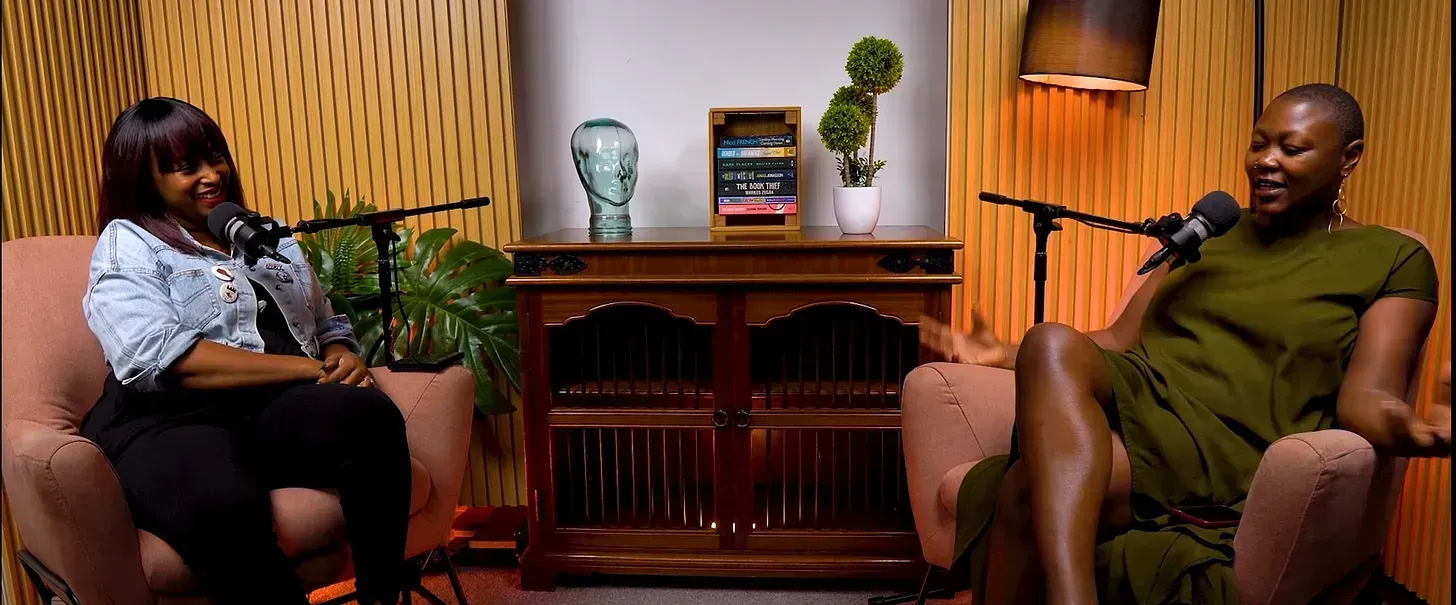
When Abigail joined Kui on Nairobi Book Love, The Podcast, the conversation quickly became less of an interview and more of a free-flowing meditation on writing, creativity, privilege, boredom, poetry, publishing, film, and what it actually means to choose storytelling as a life.
Writing Begins in Boredom
For Abigail, everything begins with writing, and writing begins with boredom.
Growing up largely alone in Ethiopia, with siblings much older than her and with limited access to television, she read constantly. Three books a day wasn’t unusual. Books were not just entertainment, they were companions.
“I really think boredom is important for creatives,” she says. “If necessity is the mother of invention, then boredom is the engine of creativity.”
That solitude created space — for imagination, for play and for early storytelling experiments. Looking back, she credits those long stretches of ‘doing nothing’ for shaping her creative instincts.
From Poetry to Journalism — and Back Again
Before columns and scripts, Abigail was a poet.
She studied journalism at United States International University (USIU) Africa, graduating with honours, alongside a minor in human sexuality and literature - a combination that later made perfect sense when you consider her body of work.
While she worked for Nation Media Group and other publications, print was always a means rather than an end. Writing, in all its forms, remained the core.
Her first book, Akello (2014), a full-length poetry anthology, was self-published after repeated rejections from publishers uneasy about poetry, sexuality, and books without a clearly stated ‘moral’.
“I was literally asked, ‘Does your book have a moral?’” Abigail reminisces.
It was a familiar Kenyan publishing story: cautious publishers, poetry treated as niche, and an industry still haunted by the rigidity of 8-4-4 literature trauma.
So she published it herself.
On Publishing, Privilege, and the Myth That ‘Kenyans Don’t Read (Poetry)’
Abigail is candid about the structural challenges writers face.
Writing a full novel, she argues, is a resource-heavy privilege — time, money, emotional bandwidth, and institutional support. That’s why many writers gravitate toward poetry, short stories, and anthologies: they are more survivable forms.
‘Kenyans don’t read poetry’ is a myth she firmly rejects. “If there’s no poetry on the shelves, how are people supposed to read it?”
She points out that Kenyans are constantly publishing; anyone who has queued for an ISBN at the Kenya National Library knows this. The issue isn’t a lack of writers or readers, but access, distribution, and an industry still overly dependent on textbooks.
From Rejection to Rugano Books
When bookstores hesitated to stock her work — citing page length, marketability, or endlessly postponing — frustration turned into action. If the bookstores wouldn’t stock Kenyan writers, she’d build one.
That’s how Rugano Books was born: an online bookstore dedicated to Kenyan and African authors who struggled to find shelf space. Named after the word for “story” across several Bantu languages, Rugano became both a business and a quiet act of resistance.
“Why are we struggling like this?” she remembers her partner at the time positing. “So, we just did the thing.”
Poetry, Sex, and Children’s Books (Yes, All of It)
Abigail’s bibliography refuses neat categorisation: Akello — a full-length poetry anthology, A Side of Raunch — a short, R-rated poetry chapbook (best hidden from parents and pastors) and multiple children’s books and comics, including mystery stories and a forthcoming comic on menstrual health.
Her work reflects a refusal to treat readers as one-dimensional, or to sanitise creativity for comfort. “Poetry has no rules,” she insists. “It doesn’t even have to make sense, except to you.”
Scripting, Film, and the Exhaustion of Structure
While poetry is freedom, scripting is discipline, and discipline is hard.
Abigail has written for numerous Kenyan and African TV productions, including Higher Learning, Block D, How to Find a Husband (Abigail herself sung the theme song to this-we BEG you to You Tube it!), Lies That Bind, the Kalasha Award winning Pepeta, as well as numerous projects for Showmax and Fox Africa.
Scripting, she says, is the most draining form of writing she does; physically, mentally and emotionally. “It drains you completely. You need self-care after.” Yet it’s also where collaborative storytelling shines, particularly in projects like Pepeta, which took years of research, lived experience, and patience to bring to screen.
Becoming a Director (Almost by Accident)
Directing wasn’t part of the plan, until suddenly, it was. In a writers’ workshop that quietly morphed into production, Abigail found herself not just writing, but co-directing, pushed gently but firmly by fellow creatives who saw her potential before she did.
“When are you going to get the resources of the privileged to explore your writing differently?” she was asked.
She listened. In doing so, she became one of the few women directing within Kenyan film spaces, and a reminder of how often women must be nudged into roles they’re already qualified for. Abigail’s directoral debut, Bella Is Dying Maybe Next Week, stars Kui Kabala (wink).
Why Writing Still Matters
Despite the exhaustion, uncertainty, and constant reinvention, Abigail remains deeply committed to writing as a way of being. “I’m still shocked every day that I get to do this,” she admits, “but creatives change worlds with words.”
And that is exactly why conversations like this matter.
Listen to the full conversation below, and don’t forget to ‘like, share, and subscribe!’